Declutter the Toys Before Christmas: A Teacher’s Toy Rotation System
Too many toys and nowhere to put the new ones? Here’s the simple toy rotation system I used in my classroom, plus the bins and shelves that make it easy…
This post contains affiliate links. If you buy through them, I may earn a small commission at no extra cost to you. Read the full disclosure.
Every December, the same thing happens in our house: new toys arrive, and there’s nowhere to put them. The playroom is already full, the bins are overflowing, and the kids can’t find the toys they actually love because they’re buried under ones they’ve outgrown.
When I was teaching, my classroom had more materials than any one group of kids could use at once. The trick wasn’t having less. It was rotation: only a few things out at a time, everything else stored and swapped in every few weeks. Kids played longer, cleaned up faster, and got excited about “new” toys that had simply been in the closet for a month. It works just as well at home, and November is the perfect time to set it up, before the holiday wave hits.
Why toy rotation works
- Fewer choices, deeper play. With 8–10 toys out instead of 50, kids actually settle in and play instead of dumping bin after bin.
- Cleanup kids can handle. A small set of toys with an obvious home is something a three-year-old can put away on their own.
- Old toys feel new. A toy that’s been away for a month gets played with like it just came out of the box.
- You make room for gifts. Clearing out now means holiday presents have a place to land.
How to set up a toy rotation in one afternoon
- Gather everything in one spot. Pull toys from every room into one pile. It looks worse before it looks better, and that’s normal.
- Sort into three piles: keep, donate, toss. Toss broken toys and anything missing key pieces. Donate what your kids have outgrown or never play with. Keep the rest.
- Group the keepers by type. Building toys, pretend play, vehicles, puzzles and games, art supplies, stuffed animals. Kids play in categories, so store in categories.
- Split each group into 3 or 4 sets. Each set should have a little of everything: something to build, something to pretend with, something quiet.
- Put one set out. Use open bins or shelves at kid height so they can see and reach everything.
- Store the rest out of sight. Clear, lidded bins in a closet or garage work best, so you can see what’s inside at a glance.
- Swap every 2–4 weeks. When play starts to fade or the room starts to feel chaotic again, trade the current set for a stored one.
Teacher tips for making it stick
- Label the bins with pictures. A photo or drawing of what goes inside lets pre-readers clean up on their own.
- Keep favorites out of the rotation. A lovey, a current obsession, a few always-there books stay put. Rotation should feel fun, not like losing something.
- Let kids help choose the next set. “Should the dinosaurs or the train come out next?” gives them ownership.
- Do a one-in, one-out after the holidays. When new gifts arrive, a few older toys go into storage or the donate bin.
Storage that makes rotation easy
You don’t need a special system. You need two kinds of storage: open bins kids can reach for the toys that are out, and clear lidded bins for the toys that are resting. Here are the pieces I’d pick.
1. Humble Crew 16-Bin Toy Organizer (Walmart): best for the toys that are out
Open, kid-height bins are the heart of a rotation. This organizer holds 12 standard and 4 large plastic bins that slide out easily, so kids can grab a bin, carry it to the rug and slide it back. With only one set out at a time, each bin holds one kind of toy.
Best for: toddlers and preschoolers who clean up best with open bins
2. 11″ 6 Cube Organizer White – Brightroom™ (Target) – will be a staple in your house for years to come
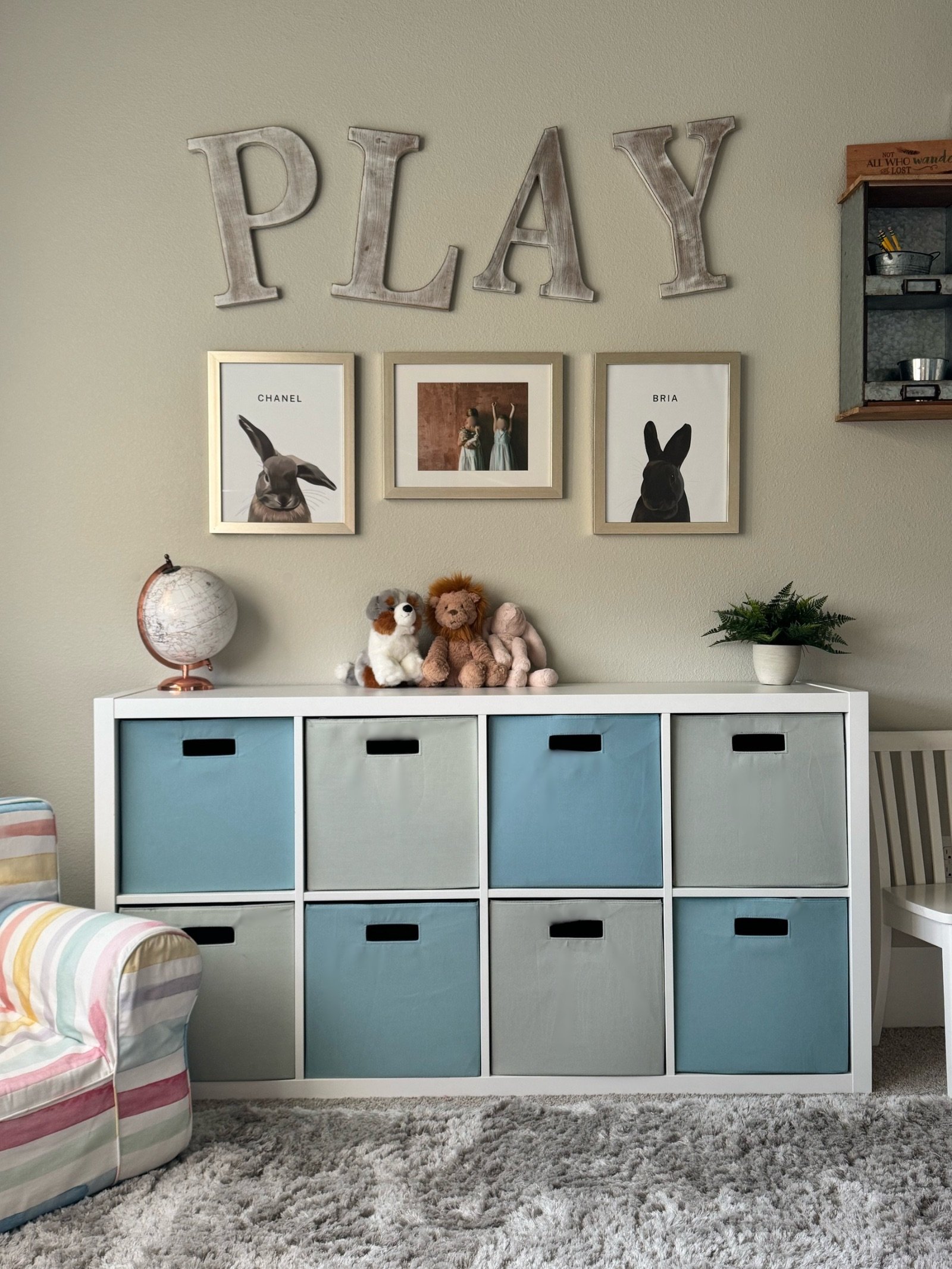
A cube organizer works as a toy shelf now and a bookshelf or craft station later. Use the lower cubes for the current toy set and the top cubes for things you want out of little hands’ reach.
Best for: families who want furniture that grows with the kids
3. Brightroom 13″ Fabric Bins (Target): best cube bins
These fabric bins fit the 13″ cube organizer above and are one of Target’s best-reviewed storage pieces. They’re light enough for kids to pull out and carry, and soft enough that nobody gets hurt when a bin tips over.
Best for: hiding visual clutter in cube shelves
4. Brightroom 6L Stacking Clear Bins with Lids (Target): best for small-piece sets
Small, clear and stackable, these are perfect for the toys that come with a hundred tiny pieces: figurines, play food, small building sets. Kids can see what’s inside, and the lids keep everything together when the set goes back into storage.
Best for: toys with lots of little pieces
5. Brightroom 32-Quart Clear Latching Bins (Target): best for storing rotated-out toys
When a set comes off the shelf, it goes into one of these. They’re long and shallow enough to slide under a bed or stack on a closet shelf, and the clear sides mean you can see which set is which without opening every bin.
Best for: closet, garage or under-bed storage
6. Brightroom 3-Tier Utility Cart (Target): best for art supplies
Art and craft supplies are their own kind of chaos. A rolling cart keeps markers, paper and playdough together and moves to the kitchen table for projects, then rolls back out of the way.
Best for: a mobile art station
7. RiverRidge Kids Corner Playroom Cabinet (Wayfair): best for small spaces
Corners are wasted space in most playrooms. This cabinet tucks into one and gives you six cubbies plus angled shelves for books, so the current toy set has a home without taking over the room.
Best for: small playrooms and bedroom play corners
The bottom line
A toy rotation is one of the simplest systems I know, and it works for almost every family. Fewer toys out means calmer play, easier cleanup and room to breathe before the holidays. Start with one afternoon of sorting, put one set out, and see how your kids play this week.
Want a room-by-room plan for the rest of the house? Get the free decluttering checklist, with a whole section on the playroom.