The Teacher-Tested Morning Routine That Makes School Mornings Calmer
The teacher-tested system that took our school mornings from frantic to calm, with checklists the kids can actually follow.
This post contains affiliate links. If you buy through them, I may earn a small commission at no extra cost to you. Read the full disclosure.
If you’ve ever stood at the front door at 7:40 a.m. holding one shoe, a permission slip, and a granola bar while someone yells “Where’s my water bottle?” from upstairs, this post is for you.
Before I stayed home with my girls, I taught elementary school. Every morning, twenty-five kids walked into my classroom, and within ten minutes they’d hung up their coats, turned in their folders, and started their morning work, mostly without me saying a word. It wasn’t magic. It was a system: everything had a home, every step was posted where they could see it, and we practiced it until it ran itself.
Then I came home and tried to get two girls, now 8 and 10, out the door with a golden retriever named Louie weaving between their feet, and I realized I’d never set up that same system at home. So I did. This is the exact morning routine system we use, built the way I’d build it for a classroom.
Why a system works better than reminding
In the classroom, I learned that kids don’t fall apart in the morning because they don’t care. They fall apart because there are too many decisions and too many things to find, all at once. A good system takes the decisions away.
Three classroom rules we use at home
- Everything has a home. If a backpack doesn’t have one exact spot, it ends up on the kitchen floor, the couch, or the car.
- Make the steps visible. Kids follow a picture or a checklist far better than a parent’s voice repeating the same thing for the fifth time.
- Do the hard part the night before. The calmest classroom mornings started with prep the afternoon before. Homes work the same way.
Our morning routine system, step by step
Step 1: The 10-minute evening reset
The morning actually starts the night before. After dinner, each girl does a quick reset before screens or reading time:
- Backpack packed and zipped, with homework and signed papers inside.
- Clothes picked out, including socks (the socks are always the problem).
- Water bottle washed and on the kitchen counter.
- Shoes in their spot in the garage.
I set a timer for 10 minutes and we do it together. In my classroom we called it “pack-up,” and the name stuck at home too.
Step 2: A drop zone by the door
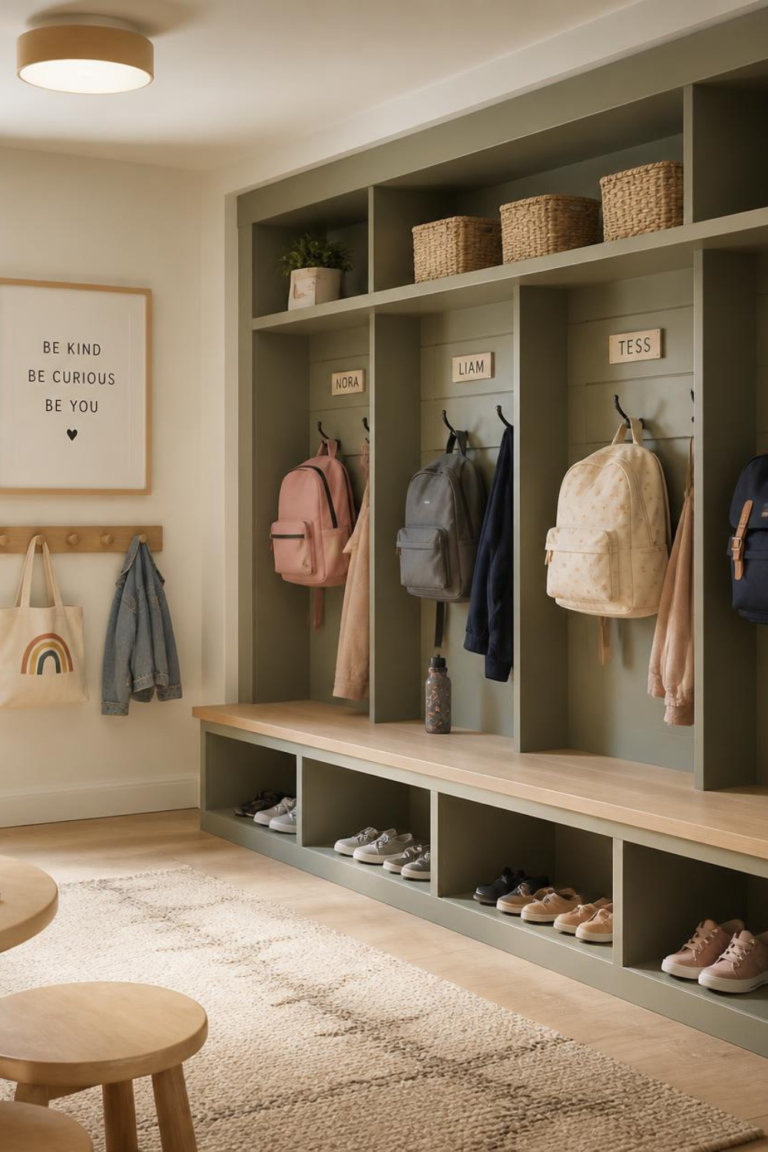
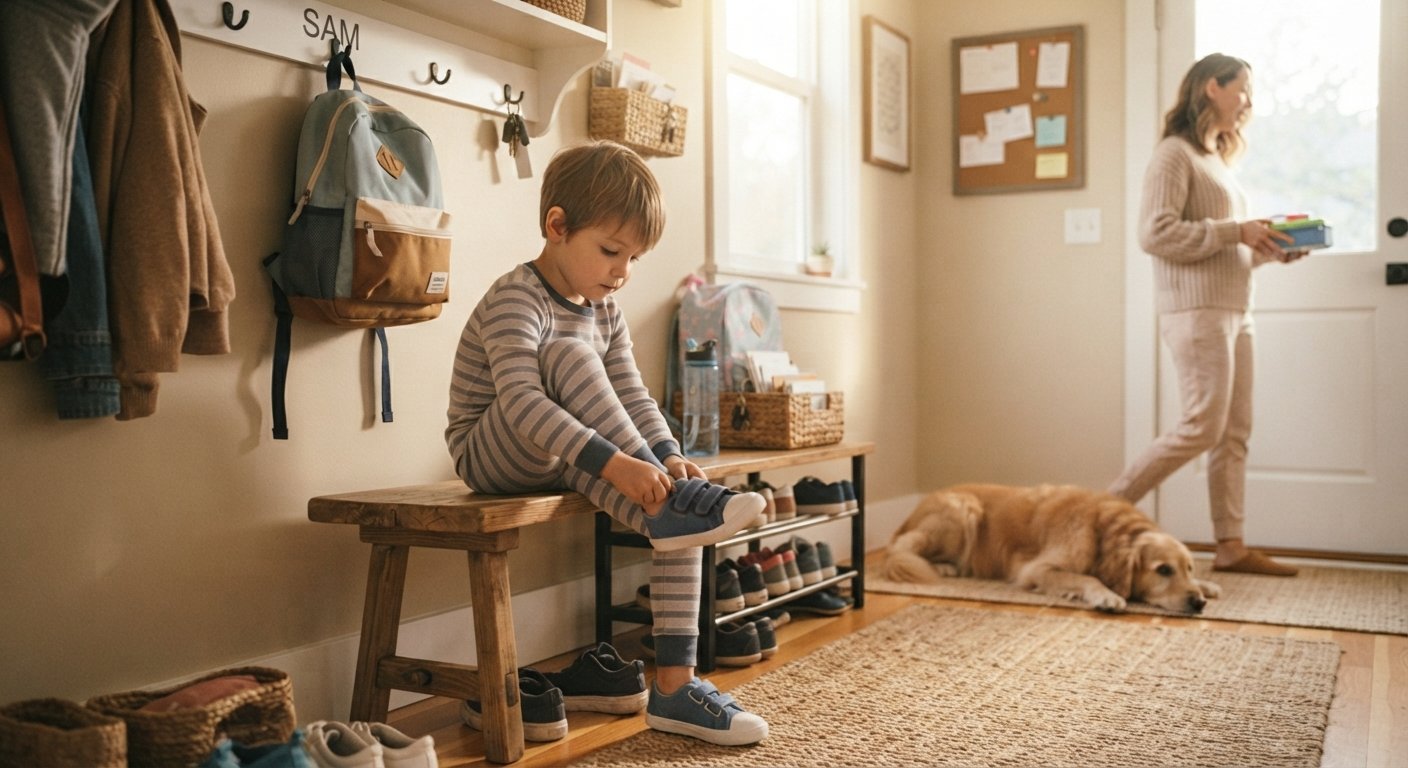
This is the heart of the whole system. Every school item lives in one spot by the door we leave from, the same way every student had a cubby and a coat hook. Ours has a hook for each girl’s backpack and jacket, a basket for shoes and socks, and a small tray for keys and anything that needs to go out the door with me. Louie’s leash hangs there too, just in case he gets to jump in the car for drop off.
The rule is simple: if it goes to school, it lives in the drop zone. Nothing gets left on the stairs or kitchen island.
Step 3: A visual checklist they can follow on their own
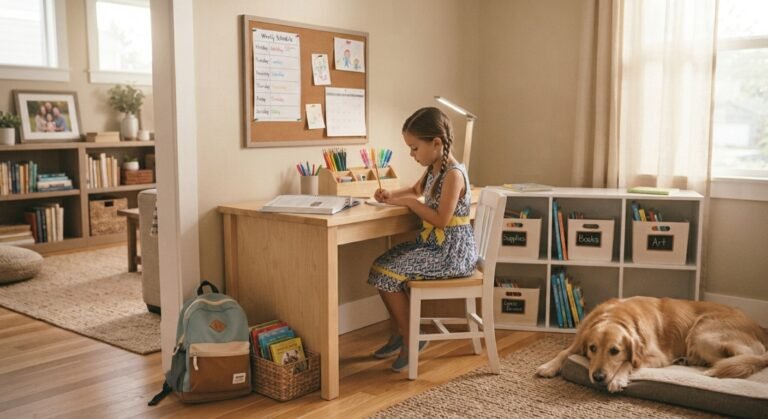
In my classroom, the morning steps were posted on the wall, and kids checked them off without asking me. At home, each girl has a checklist at her own eye level, one in the bathroom and one in the drop zone. They use a dry-erase marker to check things off:
- Get dressed
- Make bed
- Breakfast
- Brush teeth and hair
- Backpack, water bottle, shoes
- Jacket on, out the door
My 8-year-old loves checking the boxes. My 10-year-old pretends she doesn’t need it, but she still uses it.
Step 4: A simple timeline with one buffer
We work backward from the time we need to leave, and we build in a 10-minute buffer for the things that always happen: a lost hair tie, a spilled cereal bowl, or Louie stealing a sock.
Our school-morning timeline
- 6:30 a.m.: Wake up, get dressed, make beds
- 6:50 a.m.: Breakfast
- 7:10 a.m.: Teeth, hair, final checklist
- 7:20 a.m.: Shoes and jackets at the drop zone
- 7:30 a.m.: Buffer time, then out the door
Setting up your drop zone
You don’t need a mudroom. Ours started as a blank wall in our garage: a hook for each girl, a basket for each girl, a spot to sit and put on shoes, and a tray for the papers that need a signature. Label everything with each child’s name or color. In the classroom, labels turned “Where does this go?” into a question kids could answer on their own.
For the full step-by-step setup and the exact hooks, baskets, and bench we use, read my guide: How to Create a Backpack Drop Zone Your Kids Will Actually Use.
How to make it stick
- Practice it like a fire drill. In the classroom, we practiced routines the first week of school until they were automatic. Walk through the morning with your kids on a calm weekend day before you expect it to work on a Monday.
- Let them own it. Let each child pick their hook, decorate their checklist or chalkboard with their name, or choose their basket color. Kids follow systems they helped build.
- Praise the routine, not the rush. “You did your whole checklist on your own” goes further than “Thank you for finally being ready.”
- Expect a reset after breaks. After winter break or summer, routines slip. That’s normal. Just practice again for a few days.
The bottom line
The calmest mornings in our house aren’t the ones where everyone wakes up in a great mood. They’re the ones where the backpacks are already packed, the shoes are where they belong, and the girls know exactly what comes next. Set up the system once, and it does the reminding for you.
Want our printable morning checklist? Sign up for the Living Layer newsletter and I’ll send it straight to your inbox, along with our free chore chart.