How to Create a Backpack Drop Zone Your Kids Will Actually Use
Hooks, a bench and a basket per kid. Here’s how to set up a backpack drop zone that gets everyone out the door with fewer tears.
This post contains affiliate links. If you buy through them, I may earn a small commission at no extra cost to you. Read the full disclosure.
Here’s something I’ve accepted: when my girls walk through the door after school, they are not thinking about organization. They’re thinking about snacks. They’re thinking about getting their stuff done so they can have their screen time. And they’re dropping their backpacks approximately wherever they happen to be standing when they stop moving.
For a long time, I fought this. Then I stopped fighting it and started designing for it. That’s something I learned teaching elementary school: you don’t build a system for kids at their best. You build it for kids who are hungry, tired, and mid-sentence about something that happened at lunch. A backpack drop zone works when it’s so easy and obvious that a kid can use it on autopilot.
Meet the kid where they are, not where you wish they were. Here’s how to set up a drop zone that actually holds.
Pick one spot and commit to it
The most common mistake with entryway organization is trying to manage everything at once: shoes here, coats there, backpacks in the closet, sports gear in that corner. It sounds tidy in theory. In practice, it means your kid has to make four decisions the moment they walk in the door, and none of them will get made correctly.
Pick one landing spot, one place where the backpack, the jacket, and the shoes all live together. It doesn’t have to be beautiful. It has to be specific.
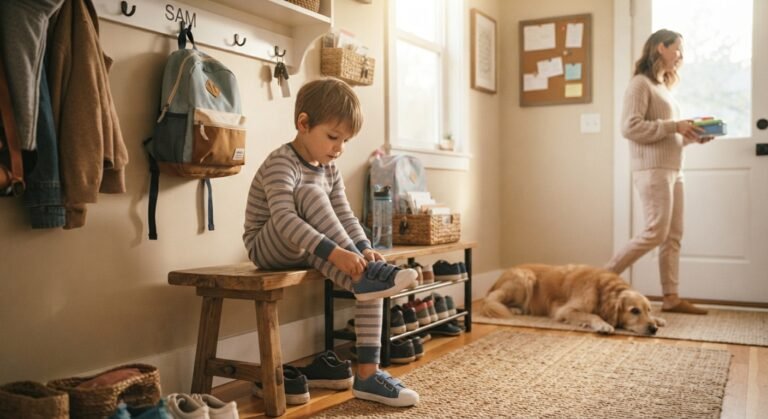
For us, it’s in our garage: two hooks at kid height, a small bench below with baskets and space for shoes, and an extra basket on the shelf for the stuff that accumulates (hair ties, sunglasses, and the occasional rock my youngest has decided to bring home from school).
Hooks at the right height
This sounds obvious, but it’s easy to get wrong. Hooks that are too high mean your kid physically can’t hang their own bag, which means you’re hanging it for them every day, which means the system breaks down the moment you’re busy. Kid-height hooks mean they can do it on their own. That’s the whole point.
Hook height guide: For younger kids, plan for hooks around 42 to 48 inches off the floor. For older kids, 52 to 56 inches works. If you have kids at different stages, stagger the hooks: a lower one and a higher one, side by side.
What we use: matte black wall hooks
Simple metal hooks that screw into the wall, one per girl. They’re inexpensive, sturdy, and hold up to 10 pounds each, which covers a jacket and a typical school backpack.
A shoe spot that’s easy to use
The shoe spot doesn’t need to be a built-in mudroom bench. It needs to be specific and at floor level, directly at the drop zone, not across the room. It should be obvious enough that a distracted kid can find it without looking for it.
We use a small bench right below the hooks. Each girl has her own spot for shoes. The rule is: shoes go away when you come in, not when you feel like it. That rule took about a month to actually stick. Now it’s automatic.
If you want a seat too: an upholstered storage bench
An upholstered storage bench gives kids a place to sit while they put on shoes, and closed storage hides the pile.
Don’t forget the floor. Muddy shoes and wet paws land here first (hi, Louie), so put down a rug you can toss in the wash. See our favorite washable rugs.
The basket for everything else
There is always stuff that doesn’t have a category: hair ties, a small toy someone carried home from a friend’s house, that rock. One basket (not a whole organizer system, just one basket) gives all of it somewhere to land that isn’t the floor. Once a week, we empty it, put things back where they belong, and reset.
Bonus: when you can’t find something, check the basket. It’s almost always there.
What we use: woven water hyacinth baskets
They add warmth to the space and fold flat when you don’t need them. They come in a set of two, so the second one makes a great shoe bin or a spot for library books.
One more thing: a tray for papers
Permission slips, unfinished homework, and school order forms don’t belong in the junk basket, where they disappear. A canvas letter tray gives them their own spot until they’re signed and back in the backpack.
Label it (seriously)
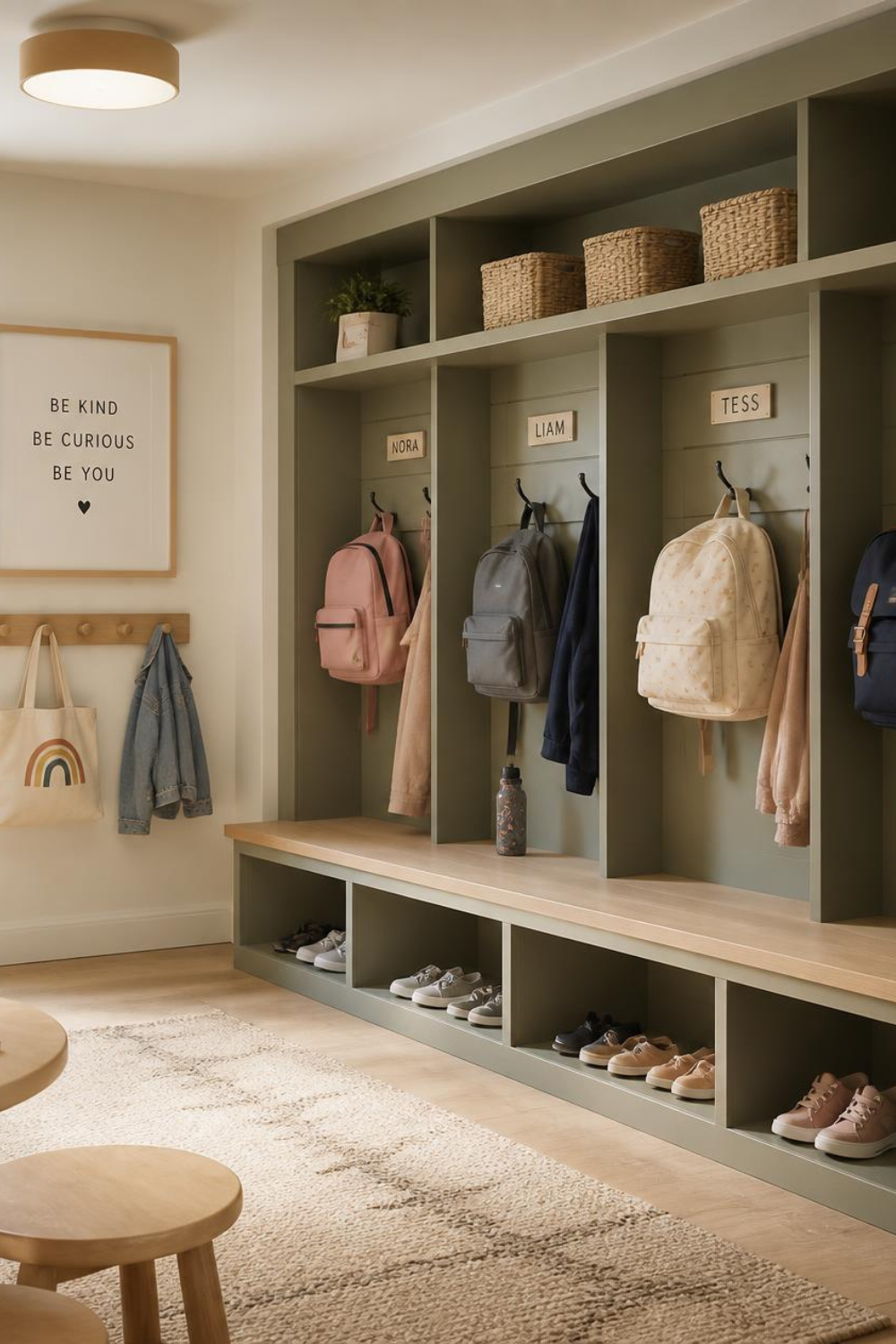
Labels feel like overkill until you’re the parent who isn’t home and your kid can’t remember which hook is theirs. A small name label on a hook, a cubby, a cute chalkboard, or a basket ends the daily negotiation over whose spot is whose. In my classroom, every cubby had a name on it for exactly this reason. For younger kids especially, it also gives them ownership: this is my spot, my hook, my things.
You don’t need a label maker (though they are extremely satisfying). We used small chalkboards. I also picked up wooden letters from Michaels, and the girls painted and glittered them for name plates. We hung them right next to their spots, and they’re still the girls’ favorite part of the whole setup.
Tie it to the routine
The drop zone only works if it becomes automatic, and habits don’t form by accident. For the first few weeks of school, the routine needs a verbal anchor. Ours is simple: “Backpack on the hook, shoes away, then snack.” In that order, every day. After about three weeks, they stopped needing the reminder. The habit was set.
If you want to back it up visually, post a small “when you get home” checklist at the drop zone. Three steps, maximum. Add pictures if your kids are younger.
The drop zone is also the backbone of our school mornings. If that’s your next battle, here’s how we use it in The Teacher-Tested Morning Routine That Makes School Mornings Calmer.
What to do in a small space
Not everyone has a mudroom, a garage, or a dedicated entryway. If you’re working with a small apartment hallway or a front door that opens right into the living room, the principles are the same. You just scale down.
- Two hooks on the wall. That’s your drop zone. Add a small basket on the floor below it. The same hooks and woven baskets we use work perfectly in a small space.
- Over-the-door hooks. If you can’t put anything on the walls, an over-the-door hook rack on the inside of a closet door near the entry works well. This one fits doors up to 1¾ inches thick and has five hooks, enough for a backpack and a jacket per kid.
- A small bench with shoe storage underneath. Shoes go on the shelf below, and the backpack goes on top. This cushioned bench is just under 24 inches wide and 12.5 inches deep, so it fits in even a narrow hallway.
The size of the space doesn’t decide whether the system works. The clarity of it does.
Want a printable “when you get home” checklist for your drop zone? Sign up for the Living Layer newsletter and I’ll send it straight to your inbox.